
Data Breaches
- Overview
- Quick Start
- Guidance, Documents & Policies
- Checklist
- Accountability Check
- Examples of Breaches
- Examples & Advice
- FAQs
- Ask a Question
Need to report a data breach? Use the Breach Log.
This best practice area pulls together all our relevant content on data breaches.
This includes:
- Data Breach Procedure
- e-learning and drip-feed posters
- FAQs
- Links to other relevant best practice
Data breaches should be kept at the forefront of your data protection planning, as they can result in the most disruption and harm.
Why?
The GDPR introduced a duty on all organisations to report certain types of a personal data breach to the relevant supervisory authority (The ICO). This must be done within 72 hours of becoming aware of the breach, where feasible:
- If the breach is likely to result in a high risk of adversely affecting individuals’ rights and freedoms, individuals must also be informed without undue delay;
- Organisations should ensure they have robust breach detection, investigation and internal reporting procedures in place. This will facilitate the decision to notify the ICO and/or the affected individuals;
- Organisations must also keep a record of any personal data breaches, regardless of whether they require notification to the ICO.
Always log your data breaches and get in touch with DPE if you require urgent assistance at
Data Breach Next Steps
Follow these steps to manage a personal data breach
Review Guidance & Log the Breach
Read the Data Breach Best Practice Area before proceeding. Log the incident on the Knowledge Bank Breach Log as soon as it is discovered. If you have any questions, then add a ticket from the log, by clicking on the 'Need Help? Log a ticket' button on the top right of the log; this links them both together.
Contain the Breach
Take immediate action to stop further loss, unauthorised access, or disclosure of data. Where possible, recover any data that has gone missing. Ensure you add any actions you have taken to the breach log.
Notify Affected Individuals (if required)
Where the breach is likely to result in a high risk to individuals' rights and freedoms, inform them without undue delay, explaining the nature of the breach and what they can do to protect themselves. Ask our advice if you need to.
Document the Breach
Record the facts, effects, and remedial action taken, regardless of whether the breach met the threshold for ICO notification.
Review & Prevent Recurrence
Identify the root cause and put in place measures, training, or policy changes to prevent the breach from happening again.
Need Help?
Click the 'Need help? Open a ticket' button in the breach log you created. This will copy across all the information from the log to the ticket, and they will be linked.
Guidance and procedures
document Data Breach Procedure(5.18 MB)
Also review Information and Cyber Security Best Practice Area
Log a data breach
To report data breaches - use the Breach Log
spreadsheet
Data Breach Assessment Matrix(5 KB)
Letter templates
document Data Breach Notification Letter to Data Subject(8 KB)
Related Best Practice Areas
Drip-feed posters
| Recognising a data breach | Responding to a data breach | |
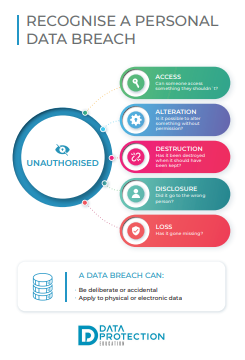 |
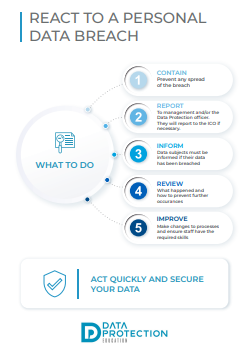 |
e-Learning
Learning nuggets:
External links
Information Commissioner's Office: Personal data breaches
Data Breaches Accountability Tracker
Work through the full framework for data breaches.
Examples of breaches
- Loss or theft of paper records or loss or theft of equipment on which data is stored, e.g. a laptop, mobile phone, tablet device or memory stick;
- A letter or email containing personal and/or confidential data sent to the wrong address (including internal staff or third parties) or an email to an unauthorised group of email boxes;
- Personal data disclosed orally in error in a meeting or over the phone – including “blogging”, where information is obtained by deceiving The Organisation or where information has been disclosed without confirming the true identity of the requester;
- Unauthorised access to information classified as personal or confidential, e.g. attaching documents to an outlook diary appointment that is openly accessible;
- Posting information on the world wide web or on a computer otherwise accessible from the Internet without proper information security precautions;
- Sensitive information left on a photocopier or on a desk in County Council premises;
- Unauthorised alteration or deletion of information;
- Not storing personal and confidential information securely;
- Not ensuring the proper transfer or destruction of files after the closure of offices/buildings, e.g. not following building decommissioning procedures;
- Failure to safeguard/remove personal data on office equipment (including computers and smartphones) before disposal/sale.
Examples of Breaches caused by IT Security Incidents:
- Unauthorised access to IT systems because of misconfigured and/or inappropriate access controls;
- Hacking or phishing attacks and related suspicious activity;
- Virus or malware attacks and related suspicious activity;
- ICT infrastructure-generated suspicious activity;
- Divulging a password to another user without authority.
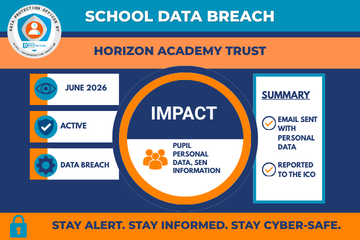
Human Error and High Stakes: What the Horizon Academy Trust Incident Teaches Us About School Data Breaches
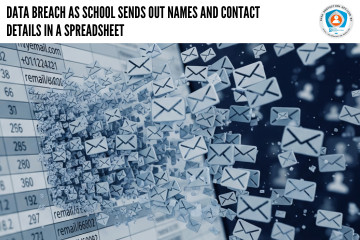
Data Breach: School sends out names and contact details in a spreadsheet.
The Online SCR Data Breach: What You Need to Know
Why Physical and Data Security Must Go Hand-In-Hand
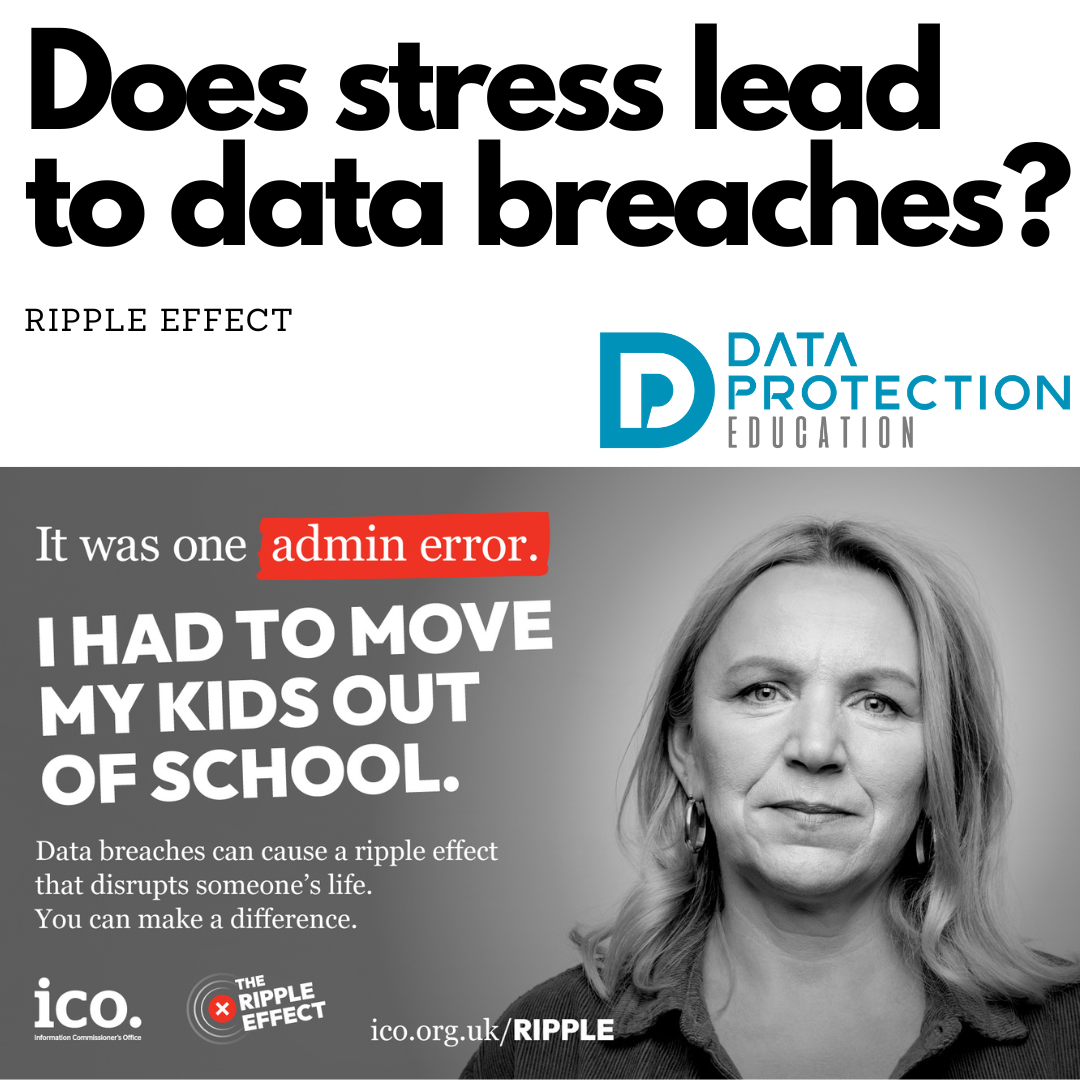
Does stress lead to more data breaches?
HCRG Care Group data breach
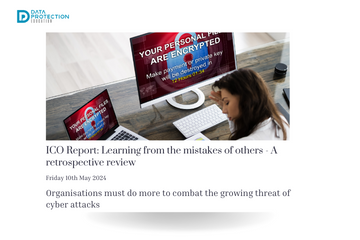
ICO: Learning from the mistakes of others report

Why Data Should Stay Put: Benefits of Keeping Data in Its Original System
The Perils of Paper: The Printing Vulnerability
Cyber Attack on a School
The Mother of all Breaches
ClassCharts Possible Data Breach

Where is your data stored?

If you suspect a financial scam .....
The ICO reprimands a Multi Academy Trust

Lettings Best Practice and Guidance
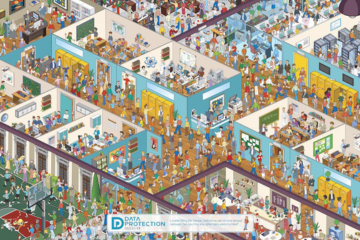
Where's Harry the Hacker?
The ICO Reprimands a school

How to contact us for support, subject access requests, data breaches and FOI's
While all ou...
Secure file transfer of files using Royal Mail
In such cases, the sender remains the data controller and is responsible for ensuring that the optimum d...
Headteacher fined for breach of data protection legislation
A former headteacher has been fined in court for unlawfully obtaining school children’s personal data from previous schools where he worked.
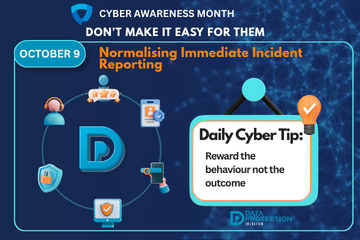
Normalising Immediate Incident Reporting | October 9
Update on Advisory for Rhysida Ransomware
The Crime in a Cyber Attack and a Data Breach
ICO Reprimand: company suffered a ransomware attack

Email and Security: ICO recent guidance
Emails...
Cyber Attack: Exam Boards

VICE SOCIETY - Ransomware attacks on schools
Cyber Attack: Leytonstone School
Be Cyber Aware: Cyber attacks and transparency. A no blame culture
January Cyber update - How Can Schools Help Prevent Cyber Attacks?
Emails – good practice and minimising the risk of a data breach
Have a question about data breaches? Ask it here.
Please use this for generic questions about breaches and breach procedures.
To report a data breach - use the Breach Log
To contact use about an urgent or specific query contact us using: