InfoSec / Cyber

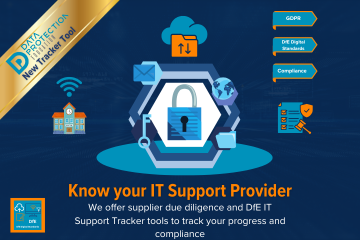
Know your IT Support Provider graphic. IT Support Due Diligence Directory for schools and colleges.

Finding the right IT partner and support provider is a big decision.  Due diligence for IT Support isn't just about who can 'fix computers', it's about ensuring standards are followed and they work with you to meet your organisation's strategy. Data Protection Education has a DfE IT Support Tracker and Supplier Due Diligence Directory to provide support and guidance as well as tracking your progress.

The Government Cyber Action Plan 2026 document. UK public sector cyber security strategy.

The Government Cyber Action Plan, published in January 2026, sets out a radical shift in how the UK public sector manages cyber security and digital resilience. It moves away from fragmented, siloed defences toward a "Defend as One" model led by a new Government Cyber Unit within the Department for Science, Innovation and Technology (DSIT).
 A promotional image for new digital standards in education.  The top half shows four primary school-age children sitting at a desk, looking down and focusing on work. The child closest to the camera on the right is smiling.  The bottom half has an orange and blue graphic overlay that reads: "New standard announced! MEETING DIGITAL STANDARDS IN SCHOOLS AND COLLEGES." In the bottom left corner is a circle image showing students working on laptops. The text "IT Support" is written in a yellow box below the circle. In the bottom right corner is a logo for the "DATA PROTECTION EDUCATION" initiative.

The government has announced an additional Digital Standard to help with planning, commissioning and reviewing their IT support services.  The services can be internal, external or a hybrid.  Effective IT support is essential for maintaining technology, planning improvements and mitigating risks like outages and cyber incidents, and sits alongside the other 11 standards.
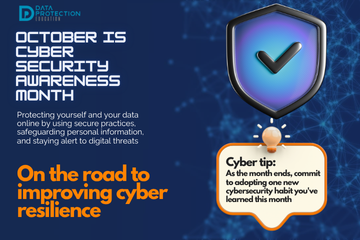
"A graphic announcing 'October is Cyber Security Awareness Month,' with text explaining the importance of creating a cyber emergency contact list in preparation for a cyber attack. It also includes a 'Cyber tip' to assess passwords, turn on MFA, and review critical accounts, especially email. A shield icon with a checkmark and a lightbulb icon are visible."

As Cyber Security Awareness Month draws to a close, it's important to recognise that cybersecurity isn't a destination; it's a continuous journey. For organisations, particularly those in the education sector, this journey often involves working towards recognised standards and certifications. In the UK, Cyber Essentials and Cyber Essentials Plus are government-backed schemes designed to help organisations protect themselves against common cyber threats. For schools, the Department for Education (DfE) Digital Standards provide additional, tailored guidance.  The Government has recently published their Cyber Assessment Framework for further best practice guidance.

  1. October 30. Cyber Support
  2. October 27. Passwords
  3. October 26. Physical Security of Digital Assets
  4. October 24. Backups: Your Recovery Safety Net
  5. October 22. Hardware: Printers
  6. October 21. Hardware: Asset Management
  7. October 20. Hardware: Safe disposal
  8. October 19. Anti-virus/anti-malware
  9. October 18. Regular Updates: Patching Against Threats
  10. October 10. Understanding Your Cyber Posture
  11. Time's Ticking: Windows 10 support ends in October 2025!
  12. October 9. A Guide for Education Providers
  13. October 4: When a Cyber Attack Hits
  14. Nursery Cyber attack
  15. The NCSC Cyber Assessment Framework
  16. The Classroom's Dark Side: Cyber crime from the Classroom
  17. The Latest Cyber Threat: The "Murky Panda"
  18. Social engineering + impersonation = Fraud ≡ cyber deception
  19. School cyber attack: Framlingham College, Suffolk
  20. Getting caught in the Scattered Spider web
  21. A Wake-Up Call for Cyber Vigilance - Danger in the Threat Landscape for Everyone
  22. Apple removes its highest level data security tool from UK customers
  23. Effectively communicating during a cyber incident
  24. Safeguarding Identity in Microsoft 365: Protecting the UK Education Sector Against Cyber Threats
  25. How does the recent global IT outage affect me?
  26. King's speech introduces new bills in relation to cyber security, smart data and digital information
  27. Free short cyber training for staff
  28. Children's mental health data leaked after a cyber attack
  29. Cyber Incident Review: The Benefits
  30. Cyber attack on a University
  31. Kent Councils Data Breach
  32. Phishing attacks targeting schools - alert from City of London Police
  33. Update on Advisory for Rhysida Ransomware
  34. The Crime in a Cyber Attack and a Data Breach
  35. NCSC Annual Review is published for 2023
  36. Learning from Data Breaches
  37. Windows 11 security ineffective against attacks on old devices
  38. International Counter Ransomware Initiative 2023 Joint Statement
  39. Top Ten Cyber Security Misconfigurations
  40. ICO Reprimand: company suffered a ransomware attack
  41. The UK Online Safety Bill becomes an Act (Law)
  42. The importance of software updates (PaperCut vulnerability and Rhysida ransomware)
  43. Ransomware, extortion and the cyber crime ecosystem
  44. Cyber Resource: The Cyber Resilience Centre Group
  45. Email and Security: ICO recent guidance
  46. What to do in the event of a Cyber Attack
  47. Cyber Crime: AI Generated Phishing Attacks
  48. Cyber Attack: Exam Boards
  49. VICE SOCIETY - Ransomware attacks on schools
  50. Be Cyber Aware: USB Sticks
  51. Cyber Insurance in the Public Sector
  52. Types of Cyber Attacks: DDos Attack (Microsoft DDoS Attack in June)
  53. Cyber Attack: Leytonstone School
  54. Be Cyber Aware: Firewalls
  55. Be Cyber Aware: Cyber attacks and transparency. A no blame culture
  56. Cyber Attack: Dorchester School
  57. Be Cyber Aware: Why regular software updates are important
  58. Cyber Attack: Wiltshire School
  59. Keeping your IT systems safe and secure
  60. Why we recommend using PIN codes on printers
  61. Types of Cyber Attacks: DDoS Attacks
  62. Types of Cyber Attacks: Phishing
  63. Types of Cyber Attacks: The Insider Threat
  64. Why your data is profitable to cyber criminals
  65. Types of malware and how they are linked to data protection
  66. How a school fought back after a cyberattack
  67. Types of Cyber Attacks - Credential Stuffing
  68. January Cyber update - How Can Schools Help Prevent Cyber Attacks?
  69. The Education sector now at highest risk of cyber attacks
  70. Cyber Attacks
  71. Emails – good practice and minimising the risk of a data breach

Search